

Core choiceVictron Orion Smart 30A Split Charge Kit
Your cart is empty
A split charge system charges your leisure battery while you drive, so every journey tops it up instead of draining it. Shop the kits below, or read on for honest sizing and the three ways we build them.
Every kit arrives cut, terminated, labelled and heat-shrunk for your van. Not sure which size? The honest sizing guide is further down the page.


The chargers are the same. The difference is how much cutting, terminating, mounting and decision-making is already done for you.
A weekend of wiring. Charger plus cable kit, terminated and labelled. Best for confident DIYers adding alternator charging to an existing 12V system.
The full 12V side of the van. DC-DC charger, 12-way fuse box, mini-busbars and every cable cut, labelled and terminated, but not mounted.
Bolt it in, in an afternoon. The entire system built, wired and bench-tested on a board before it reaches your van.
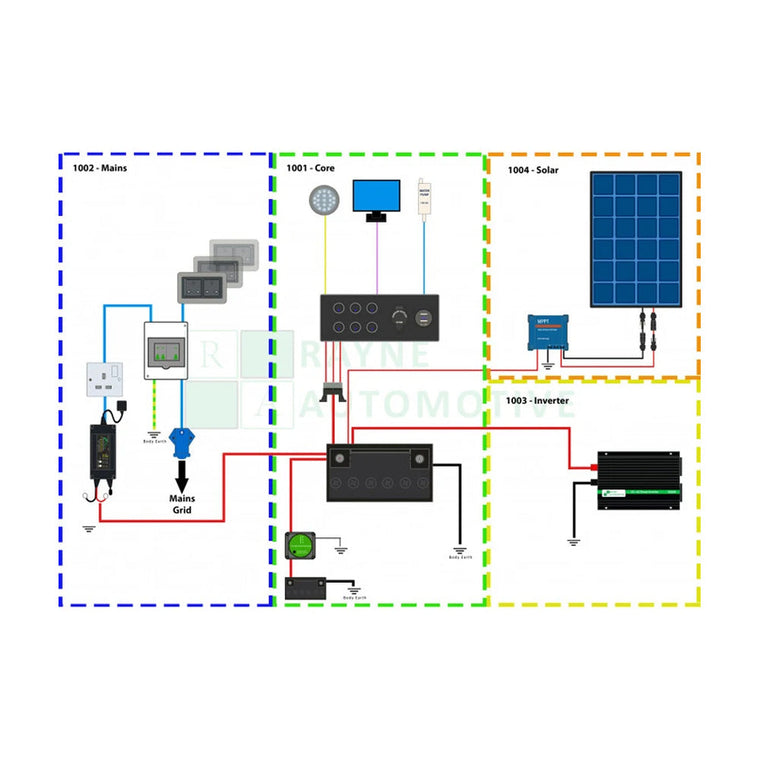
The Power Planner works from the appliances, battery bank, driving pattern and solar contribution, then builds the right route around them.
Choose the statement that best matches your build. This is a starting point, not a substitute for checking the vehicle and battery specifications.
A properly engineered VSR may be all you need. Confirm the alternator is conventional and the leisure battery is lead-acid or AGM before buying.
Read the Cyrix routeSmart alternators and lithium batteries need controlled charging. Choose amperage from battery limits, alternator headroom and driving time.
Size the charger honestlyBuild from your appliances and trip profile, then match the charger, battery and solar as one system.
Open the Campervan Power PlannerStart with the van and battery you actually have. Then choose the build format that matches your tools and confidence.
A voltage sensitive relay connects your batteries when the starter battery reaches charge voltage, and disconnects them when the engine stops. No trigger wire is needed.
The Victron Cyrix is the VSR done properly: microprocessor-controlled, with precise voltage sensing and intelligent engagement behaviour instead of one rigid threshold. It delays cut-offs to avoid clicking in and out during genuine voltage fluctuations.
It is the VSR we are happy to put our name on, for the vans that still suit one.
A DC-DC charger, also called a battery-to-battery or B2B charger, takes power from the alternator and regenerates it into a proper multi-stage charge: the right output voltage and the right profile for your battery.
A relay just passes current. A DC-DC charger actually charges.
Every charger in the range offers the same core control features and app. They differ mainly in size.
James explains DC-DC charging on camera. Five years old, still accurate.
Split charging connects your van's starter battery and leisure battery while the engine is running, so the alternator charges both.
When the engine stops, the two batteries are isolated. Your leisure equipment keeps running, and your starter battery stays charged for the morning.
Every method below does that one job. What has changed dramatically is how well each method does it on modern vans and modern batteries.
We have been building split charge systems since 2013. For the first few years, nearly every system we sold was a voltage sensitive relay, because that was what vans and batteries needed.
Then two things happened. Vans got smart alternators, which no longer behave the way a relay expects. Batteries got lithium, which demands a proper charging profile a relay simply cannot provide. Usually both happened at once.
Not because they are fashionable, but because smart alternators and lithium batteries genuinely require them.
That said, a VSR is still the right tool for plenty of vans, if it is a good one. Both routes are covered honestly below, because the right answer depends on your van, not our margin.
Amperage is where marketing meets reality. A bigger number on the box is not automatically better. The charger most of our customers actually buy is still the 18A.
Around 60% of the systems we build run a 105Ah battery. A 70A charger only makes sense on 230Ah+ banks. Fit one to a small battery and it must be turned down, so you have paid for amperage the battery cannot use.
A DC-DC charger loads the alternator. We look for comfortable headroom, normally at least double and often closer to triple the charger size. Check the alternator label or ask the vehicle manufacturer.
Driving time changes everything. A modest charger backed by long journeys can contribute more than a large charger in a van that stays parked for days.
Long daily drives and short stops. Alternator charging carries the trip, so a modest charger can achieve more than its headline amperage suggests.
Days parked on one site. The alternator barely features and solar does the heavy lifting. A giant DC-DC charger is money spent in the wrong place.
A few nights here, then drive on. This is where the blend between alternator charging, solar and stored battery energy genuinely matters.

Most vans from the mid-2010s onward use variable-output alternators designed to save fuel, not charge leisure batteries predictably. A relay can read “charging” when the alternator is just coasting.
Here is the test we have used on countless customer vans. You need a multimeter and five minutes.
Leigh demonstrates the five-minute voltage test.
Usually, yes. Solar and alternator charging do different jobs on different trips. They are partners, not rivals. The trips where solar shines are often the trips where the alternator contributes least, and vice versa.
No. Lithium batteries need a controlled charge profile that a relay cannot provide. If you have lithium, or plan to upgrade, a DC-DC charger is the correct route.
Only if the battery can accept it. On a 105Ah bank, the battery's own charge limit is the ceiling. A 70A unit comes into its own on 230Ah+ banks with healthy alternator headroom.
Classic coil relays and some systems use a D+ trigger from the alternator. The Cyrix senses voltage instead, so it does not. Orion XS chargers are similarly self-sensing, meaning one less wire into the vehicle's factory loom.
The charger itself is straightforward. Fusing, cable sizing and terminations are what matter. Our install kits arrive cut, labelled and heat-shrunk, so the difficult design decisions are made before the box ships.
A basic split charge relay switches on a signal from the ignition or alternator. A VSR senses battery voltage and decides for itself. Both are pass-through devices: suitable for some older vans, but outclassed by DC-DC charging on modern systems.
The Cyrix is microprocessor-controlled and properly engineered. A low-cost relay is a commodity switch with a threshold. On a quality installation, the VSR is one of the least expensive components, so we would rather specify the right one once.
You are in good company. Many of our customers are first-time builders. Start with the Power Planner, choose a pre-labelled kit if you want to install it yourself, or call us if you would rather talk the system through.
These supporting guides are being built as part of the new site. Their titles and internal-link slots are reserved here now.
Run your trip profile through the Campervan Power Planner. It sizes your charger, battery and solar together, and shows you what we would build.
Whether this is your first conversion or your fourth, the advice stays the same: buy the system that matches how you actually travel.


