

Your cart is empty
NCC Trained · Victron Dealer
Off-grid 230V is about more than picking the largest inverter. If your van has a mains hook-up, a Victron MultiPlus is usually the more useful starting point: it combines the inverter with mains charging and power transfer switch, meaning the same sockets are powered whether you’re on grid or off. If you only need inverter power, a standalone Victron unit remains an option. Shop the 12V range as a unit on its own or choose the installation-kit format that suits the rest of your build.
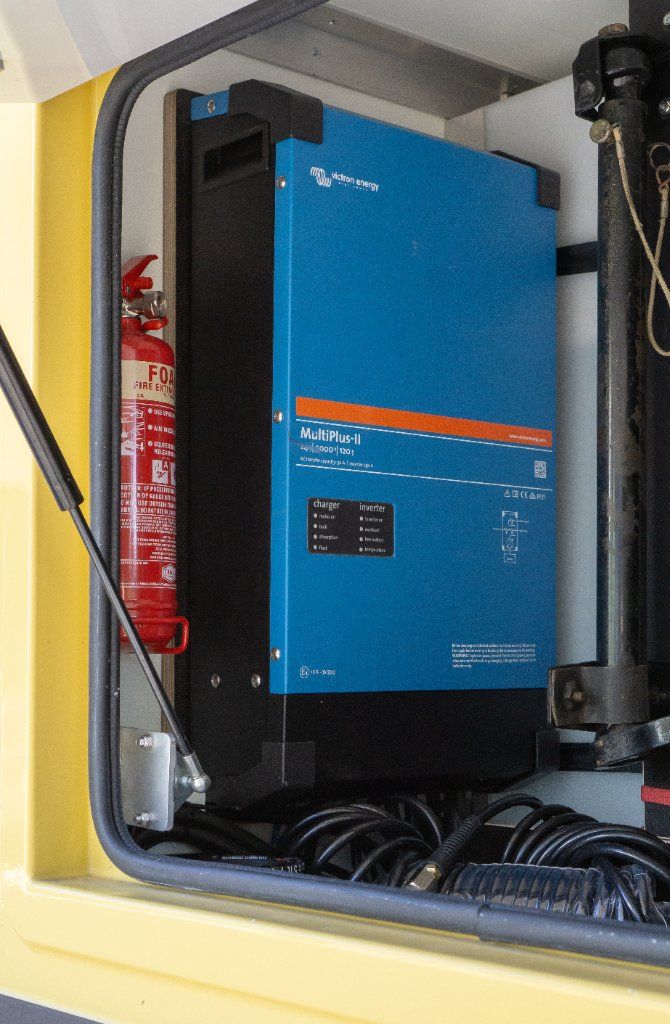
The short answer: Most campervan builds run happily on a 2000VA inverter — enough for an air fryer, an induction hob on medium, or a microwave, without dragging your battery flat. Only size up to 3000VA if you cook off-grid daily or run two high-draw appliances together. Size for the appliances you actually use, not the biggest number on the box.
Choose a starting route below, or size it from your appliance list with the wizard underneath — both lead to the right unit. For battery sizing, use the System Builder.
Choose whether a mains hook-up is part of your plan, or browse everything below. Use the System Builder to select the actual inverter size.
Tick what you want 230V for — then tell us how you cook. We size to your biggest realistic moment, not a worst-case sum of everything you ticked.
When you’re cooking off-grid, honestly — what runs at the same time?
Figures are the same measured real-world averages our Campervan Power Planner uses. The kettle here is a 0.6L travel kettle — a full-size domestic one draws far more.
Get the printable wattage cheat sheet emailed — every measured figure we use, on one sheet.
Browse every eligible 12V inverter product without answering the finder. Use the optional routes below; choose the supplied format on the individual product listing.
Showing all inverter products.


£657.78
Available to order
View options
£563.52
Available to order
View options
£329.24
Available to order
View options
£249.26
Available to order
View options
£91.77
Available to order
View options
From £451.20
Available to order
View options
£451.20
Available to order
View options
From £521.28
Available to order
View options

From £812.16
Available to order
View options
£812.16
Available to order
View options
From £286.08
Available to order
View options
£286.08
Available to order
View options
From £368.64
Available to order
View options
£368.64
Available to order
View options
From £1,019.52
Available to order
View options
£1,019.52
Available to order
View optionsThe honest way to size an inverter is on what appliances actually draw over a few minutes, not the number on their rating plate. An air fryer says 1,700W on the label but averages under 1,100W in real use; a kettle really does run at full tilt the whole time it’s on. This table uses measured, real-world averages — the same figures from our campervan cooking guide.
| Appliance | Rating plate | Realistic average draw | 2000VA MultiPlus |
|---|---|---|---|
| Air fryer | 1,400–1,700W | ~900–1,050W | ✓ Runs comfortably |
| Induction hob (medium heat) | 2,000W | ~700–900W | ✓ Runs comfortably |
| Induction hob (full power) | 2,000W | ~1,400–1,600W | ✓ Within range |
| Kettle | 2,200W | ~2,200W continuous | ⚠ Short bursts only |
| Microwave (800W) | ~800W | ~1,000–1,100W draw | ✓ Runs comfortably |
| Air fryer + induction hob together | — | ~1,600–2,000W combined | ⚠ Consider 3000VA |
A 2000VA MultiPlus delivers ~1,600W of continuous working load — we size Victron units at 80% of the VA rating, temperature compensated, so the number reflects genuine real-world output. That’s the number to match against the averages column, not the 2000VA headline.
Want the full cooking picture — battery sizes, off-grid runtimes and daily-use scenarios? Read our guide: Can I Run an Air Fryer, Induction Hob or Kettle in My Campervan?
We don’t stock a 1000W-class inverter — deliberately. Search a “1000w inverter” and you’ll mostly find modified-sine units we don’t think are the right tool for the job. Here’s the honest route instead:
Bigger isn’t always better — it’s just built for a different shopping list. Size to your appliances and you’ll spend the difference on battery instead, which is usually the smarter call.
A standalone inverter supplies 230V from your 12V battery. A Victron MultiPlus also brings mains battery charging and switching between power sources into the same system. That convenience is why Rayne Automotive usually starts with a MultiPlus when a van has a mains hook-up. A standalone inverter still makes sense when integrated mains plug-in is not part of the plan.
You can start with the unit alone or choose a kit with leads and isolator switches. For a MultiPlus mains-hook-up build, there is also a format with the mains hook-up kit, including all of the necessary circuit protection. Choose around what is already fitted and what you still need. Rayne Automotive's Victron-trained software team programmes the units in-house for their intended use case. If you're unsure which format suits your installation, tell us what you already have and what you want to run.
One high-wattage appliance can set the size of an entire system. Think about whether that appliance is genuinely part of your build. If you have several higher-power appliances that you use one at a time, the larger setup may make more practical sense. If you will use appliances together, their combined demand matters too. Rather than relying on a simple VA label or one-size-fits-all chart, plan the loads and battery in the System Builder and ask Rayne Automotive to review the result when needed.
If you plan to use a mains hook-up for battery charging, a MultiPlus is usually the more convenient route: it combines the inverter, charger and power switching. If you only need inverter power and are handling charging separately, compare the standalone Victron options. Start with the way you will use the van, then select the specific model.
That depends on the format you choose. You can buy a bare unit, a unit with leads and isolator switches, or a MultiPlus format with those parts plus a mains hook-up kit. Check the final product's variant and included-parts list before ordering.
Work from your actual appliances, their power demands and whether you use them at the same time. Your 12V battery system must also be able to support the choice. Rayne Automotive's System Builder already handles the sizing questions, so this page will not guess a model from a single appliance name.
Not necessarily. If that item is an occasional extra, it is worth deciding whether you want to size the whole system around it. But when several appliances need similar power and are used one at a time, a larger inverter may earn its place. Use your real usage pattern to decide.
The inverters and kits on this page are for 12V systems. Rayne Automotive may offer 24V products separately in future; don't choose a 12V unit for a 24V installation.
Yes. Rayne Automotive's Victron-trained software team programmes units in-house for their intended use. If you're unsure about the inverter, battery or kit format, book a consultation and tell us what you want to run and
Most builds land on a 2000VA unit. Add up the appliances you genuinely use off-grid, use their real-world average draw (not the rating plate), and size the inverter so that total sits at or under 80% of the VA rating, temperature compensated. If you cook off-grid every day, look at 3000VA — and spend on battery capacity to match.
An air fryer, an induction hob on medium, a microwave, power tools and every charger you own — comfortably. A kettle works in short bursts. Air fryer plus induction hob at the same time is the line where you want 3000VA instead. See the wattage table above for measured figures.
Yes. Pure sine is what the national grid delivers, and it’s what anything with a motor, compressor or sensitive electronics expects. All Victron inverters we stock are pure sine across the board. That’s also why the older modified-sine lines are no longer part of the range.
Browse the 12V Victron range freely, use the System Builder for model sizing, or book a consultation for help connecting the inverter choice to the whole electrical system.