
If you're planning a campervan conversion, the electrics are usually the part that causes the most confusion — and the most expensive mistakes. We've been designing and building campervan electrical systems since 2012, so in this guide we're going to cut through the noise and tell you exactly what you need, how it fits together, and where people go wrong.
No jargon overload. No upselling. Just straight answers.
First: What Does a Campervan Electrical System Actually Do?
A campervan electrical system has two jobs: store power and deliver it to the things you want to run — lights, USB sockets, a fridge, a laptop, maybe a coffee machine or an induction hob.
It does this through four main components:
- A battery bank — stores your electricity (measured in amp-hours, Ah)
- A charging system — puts electricity back in when you're driving, plugged into mains hookup, or under solar panels
- A distribution board (consumer unit / fuse box) — safely routes power to all your circuits
- Your appliances — everything from LED lights to a full 240V inverter
Getting these four things right, sized correctly for how you actually use the van, is the whole game.
12V vs 240V: Do You Need Both?
Most campervan builds run on 12V DC — it's efficient, safe, and more than enough for lights, a fridge, USB charging and a 12V compressor for your paddle board or kayak. If that's all you need, a 12V system is perfectly sufficient.
Where people often go wrong is assuming they need 240V for everything. The truth is, many 240V appliances — phone chargers, laptops, some coffee machines — have 12V alternatives that are more efficient and draw far less from your battery.
That said, if you want to run a proper induction hob, a hair dryer, a full-size coffee machine, or power tools, you do need 240V. And for that, you need an inverter — a device that converts your 12V battery power into 240V AC.
The gold standard for campervan off-grid 240V is the Victron Multiplus — an inverter/charger combo that does three things in one unit: inverts 12V to 240V, charges your batteries when you're on hookup, and seamlessly switches between the two. If you're spending serious money on a build, this is the unit.
What Battery Do You Need?
This is where most self-builders either overspend or underspend — usually the latter.
AGM batteries are cheaper upfront but you can only safely use about 50% of their capacity before you risk damaging them. They're also heavier and need replacing more frequently.
Lithium (LiFePO4) batteries cost more but are lighter, can be discharged to 80–90% of their capacity, last three to five times longer, and charge significantly faster. For a full-time or serious weekend van, lithium is almost always the better long-term investment.
How much capacity do you need? A realistic rule of thumb:
- Weekend van (two people, fridge, lights, phone charging): 95Ah AGM — from £176.98 or 105Ah lithium — from £312.10
- Regular touring (add a laptop, occasional 240V use): 105Ah lithium — from £312.10
- Full-time living or heavy 240V use: 230Ah lithium — from £515.50 paired with a Victron Multiplus
Don't undersize your battery trying to save money — it's the one thing that will cause the most frustration if it's too small.
How Will You Charge Your Battery?
You've got three main options — and most good builds use a combination of all three:
1. DC-DC charger (from your vehicle alternator) When the engine is running, power flows from the alternator into your leisure battery. A DC-DC charger (like the Victron Orion Smart 18/30A or Victron Orion XS) does this intelligently — it protects both your starter battery and your leisure battery. This is the right choice for lithium batteries; a basic split charge relay simply isn't up to the job. Browse our split charge & DC-DC kits →
2. Mains hookup (240V on a campsite) A battery charger — or the Victron Multiplus, if you have one — charges your batteries when you're plugged into a campsite hookup point. This is the fastest and most reliable way to top up overnight.
3. Solar Solar is brilliant for extending off-grid time, but it's a supplement — not a replacement for the other two. A 190W Victron panel with a SmartSolar MPPT controller is a solid starting point for most UK builds — kits start from £243.65. Browse solar panel kits →
Bear in mind: UK weather is not Andalusia. Solar is free power when the sun shines, but don't design your whole system around it.
The Wiring: Where Most People Get Into Trouble or Get Fed Up
The wiring is where corners get cut and problems develop — sometimes immediately, sometimes years later as corroded or overloaded cables cause faults or, in the worst cases, fires.
Key rules:
- Always correctly fuse each circuit — a fuse protects the cable, not the appliance
- Use the right cable cross-section for the current it carries — undersized cable gets hot
- Keep cable runs as short as possible, especially on high-current circuits like inverters and charging
- Use pure copper cable throughout — it carries current efficiently and is the correct choice for a permanent installation
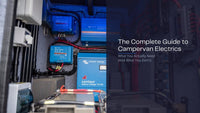
This is exactly why our pre-wired power boards exist. Every circuit is correctly sized, fused and tested before it leaves our workshop in Essex. You bolt it in, connect your battery and your appliances, and it works. No guesswork, no wiring diagrams, no lying awake wondering if you sized that cable correctly.
Pre-Wired vs DIY: Which Is Right for You?
DIY wiring makes sense if you have electrical knowledge, enjoy the process, and have time to research and get it right. The savings are real — but so is the complexity, and mistakes can be costly or dangerous.
A pre-wired power board makes sense if you want a system that's been designed, built and tested by specialists — one that you can install in a day rather than a week, with full technical support when you need it.
Our boards are built here on the Essex/Suffolk border in the heart of the countryside we love to explore, by the same team that's been doing this since 2012. They're not off-the-shelf generic units — they're configured for the kind of builds our customers are actually doing, with Victron components throughout and everything labelled, fused and ready to go. Boards range from a a solar board and a simple 12V system board. Complete bundles with 12V, 240V and solar boards are available Here.
What Does a Campervan Electrical System Cost?
Ballpark figures for a complete system including battery, charging, distribution, and inverter where applicable:
| Setup | Approximate Cost |
|---|---|
| Basic 12V (95Ah AGM, split charge, fuse box) | £400–£650 |
| Mid-range 12V (105Ah lithium, DC-DC charger, solar) | £950–£1,400 |
| Full system (230Ah lithium, Victron Multiplus, solar, DC-DC) | £2,800–£4,500+ |
The biggest variable is your battery and inverter spec. Get those right for how you actually use the van, and the rest follows naturally.
Ready to Plan Your System?
If you're not sure what you need, our Campervan Power Planner lets you input your appliances and usage patterns and get a recommended system spec — including battery size, inverter, solar and charging — in a few minutes. No email required, no obligation.
Or if you'd rather talk it through, we're on the phone. We've had this conversation thousands of times and we're happy to help you get it right first time.
Browse our pre-wired power boards → Use the Campervan Power Planner →